


The sensation of a garment against the skin is often the first and most enduring impression of quality. Yet, for many, the word "wool" evokes a paradoxical reaction: the promise of warmth shadowed by the memory of a persistent, localized itch. This tactile dissonance is not a matter of allergy, as is commonly misperceived, but a sophisticated interaction between the physics of natural fibers and the neurobiology of the human integumentary system.
In my years of exploring the intersection of material science and luxury craftsmanship, I have often observed that "softness" is treated as a subjective marketing term rather than a quantifiable engineering standard. We see it, we touch it, and we feel it—but rarely do we ask why one fiber feels like a second skin while another feels like a collection of microscopic needles. This inquiry led me to delve into the data provided by the Commonwealth Scientific and Industrial Research Organisation (CSIRO) and the foundational studies on human mechanoreceptors published in the Journal of Investigative Dermatology.
This article aims to bridge the gap between textile engineering and sensory physiology, addressing the industry pain point of "tactile discomfort" through a rigorous examination of fiber diameter, skin receptor activation, and the transformative role of high-gauge knitting.
The Mechanics of Tactile Irritation
To understand softness, we must first define its opposite: the "prickle." Tactile irritation in textiles is primarily a mechanical phenomenon. When a fiber tip makes contact with the skin, it exerts a specific amount of force. If the fiber is stiff enough to resist bending and instead pokes the skin surface, it triggers a sensory response.
Research conducted by the Woolmark Company indicates that the threshold for "prickle" sensation occurs when a fiber exerts a force of approximately 75 millinewtons (mN) or more on the skin. This force is a direct function of the fiber's diameter and its length. Coarser fibers, possessing a larger cross-sectional area, are significantly stiffer and less likely to bend upon contact, thus concentrating their force onto a single point of the epidermis.

Neurobiology of the Dermis: Mechanoreceptors at Work
The human skin is an extraordinarily sensitive organ, populated by a dense network of specialized receptors known as mechanoreceptors. These receptors are responsible for converting mechanical pressure into neural signals that our brain interprets as touch, texture, or pain.
In the context of knitwear comfort, two primary receptors are at play:
- Meissner’s Corpuscles: Located in the upper layers of the dermis, these are rapidly adapting receptors that detect light touch and low-frequency vibrations. They are the first to register the "glide" of a smooth fabric.
- Merkel Cells: These are slowly adapting receptors that perceive deep pressure and static touch. They are sensitive to the sustained "poking" of stiff fibers.
When a coarse wool fiber (typically above 25-30 microns) presses against the skin, it does not bend. Instead, it activates the Merkel cells and, in some cases, nociceptors (pain receptors), if the force is high enough. This activation is what we perceive as "itchy." Conversely, ultra-fine fibers—such as those measuring 16.5 microns—lack the structural rigidity to trigger these receptors. They bend upon contact, distributing the force across a wider area and failing to reach the activation threshold of the deeper-seated receptors.
The 30-Micron Threshold: Physics of the "Prickle Factor"
In the textile industry, the "Prickle Factor" is a critical metric defined as the percentage of fibers in a wool sample that exceed 30 microns in diameter. Statistical analysis shows that if more than 5% of the fibers in a garment are over this threshold, the wearer is highly likely to report discomfort.

This is why "micron count" is the gold standard for luxury knitwear. A lower micron count means the average fiber is thinner, more flexible, and possesses a lower "bending modulus."
| Fiber Type | Typical Micron | Comfort Level | Skin Receptor Response |
|---|---|---|---|
| Coarse Wool | 25 - 35μm | High Prickle | Strong Merkel cell activation; potentially itchy. |
| Standard Merino | 19 - 22μm | Moderate | Minimal irritation for most; sensitive skin may react. |
| Fine Merino | 17.5 - 18.5μm | High Comfort | Bends easily; triggers light Meissner feedback only. |
| Ultra-Fine (Wynool) | 14.5 - 16.5μm | Exceptional | Below receptor activation threshold; feels "liquid." |
Beyond Micron: Why 16GG High-Gauge Knitting Matters
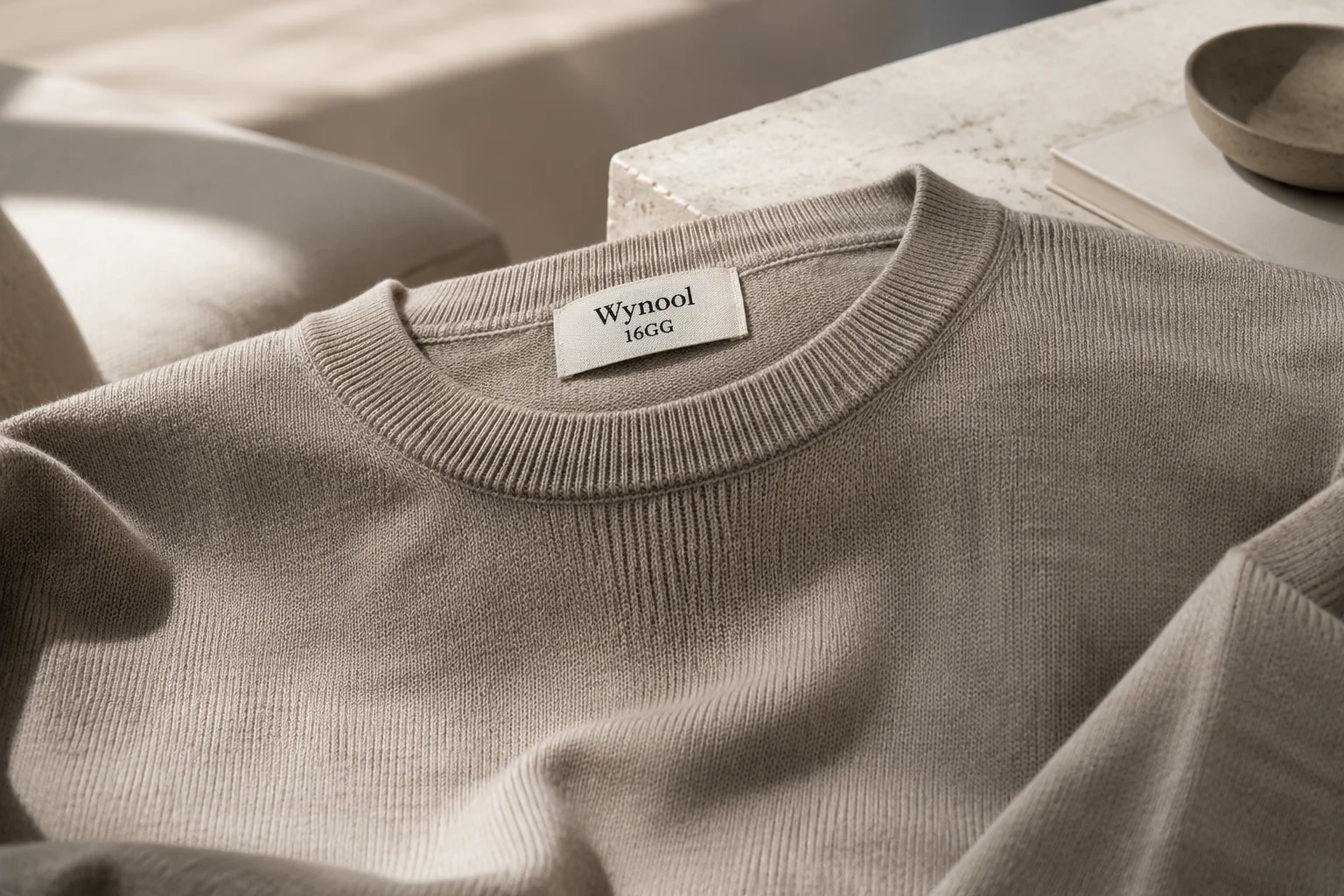
While the fiber itself is the foundation, the construction of the fabric—the "knit"—dictates how those fibers are presented to the skin. This is where 16GG (16-gauge) knitting enters the conversation of science and luxury.
Gauge refers to the number of needles per inch on a knitting machine. A 16GG machine is incredibly fine, requiring extremely consistent and high-quality yarn to operate without breakage. The resulting fabric is dense, smooth, and remarkably stable.
From a sensory perspective, a 16GG knit minimizes the "surface rugosity" of the garment. In a coarser knit (e.g., 5GG or 7GG), the gaps between the stitches are larger, allowing more fiber ends to protrude and potentially interact with the skin at varying angles. In a 16GG high-gauge structure, the fibers are held more tightly in place, creating a uniform surface that maximizes the contact with Meissner’s corpuscles (smoothness) while minimizing the opportunity for individual fiber tips to poke (prickle).
The Wynool Standard: Marrying Craftsmanship with Science
Within the landscape of premium knitwear, certain standards elevate a garment from a commodity to an engineering marvel. The Wynool approach exemplifies this by focusing on the synergy between ultra-fine fiber selection and high-gauge execution.
By utilizing fibers in the 16.5-micron range—often referred to as the "sweet spot" of luxury wool—Wynool ensures that the physical properties of the yarn are inherently compatible with human skin physiology. These fibers are so fine that they approach the tactile profile of cashmere while retaining the superior thermal regulation and moisture-wicking properties of merino wool.
The integration of 16GG technology further refines this experience. The result is a garment that does not just "sit" on the skin but flows with it. This "Quiet Luxury" is rooted in the absence of noise—the physical noise of irritation and the visual noise of coarse, uneven textures.
A Practical Guide to Skin-Friendly Selection
When investing in high-end knitwear, understanding these technical specifications allows for a more informed and satisfying purchase.
1. Check the Micron Label
Look for "Superfine" (16.5-18.5μm) or "Ultrafine" (<16.5μm) designations. These are the markers of a garment that will not itch, regardless of skin sensitivity.
2. Assess the Gauge
For base layers or items worn directly against the skin, 16GG or higher is ideal. It provides the smoothest tactile profile and the most elegant drape.
3. The "Neck Test"
The skin on the neck and the inside of the wrist is significantly thinner and more sensitive than the skin on the hands. Always test the garment's prickle factor against these areas.

Shopping Recommendations: The Wynool Signature Collection
For those seeking to experience the pinnacle of "Softness Science," I recommend the following criteria for your next acquisition:
- The Essential Crewneck: Seek a 16.5-micron, 16GG construction. This serves as the ultimate benchmark for tactile comfort. It should feel lightweight yet provide substantial thermal protection.
- The Drape Factor: A high-gauge knit should have a certain "liquid" quality in its movement. If the fabric feels stiff or "crunchy," the micron count is likely too high for luxury standards.
- Repurchase Reliability: Scientific data is one thing; long-term performance is another. Brands with high repurchase rates (often exceeding 35-38% in the luxury sector) are those that consistently meet the physiological demands of the wearer.
In conclusion, the science of softness is a testament to the fact that luxury is not an accident—it is the result of meticulous attention to the microscopic details of fiber and form. By understanding the relationship between the 16.5-micron fiber and our skin's mechanoreceptors, we can finally move beyond the "itchy wool" myth and embrace a new era of sensory-first knitwear.


